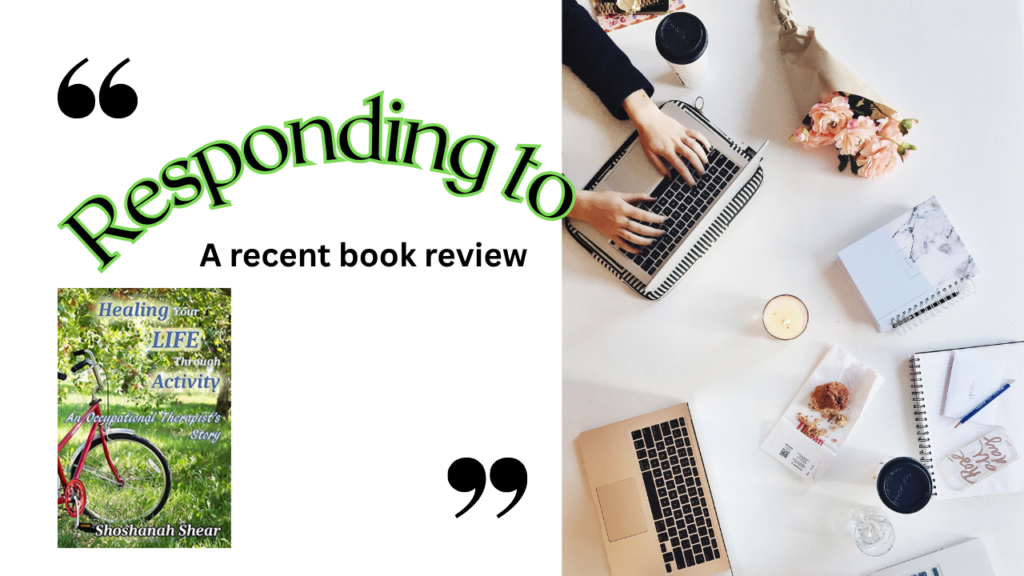
My book Healing Your LIfe Through Activity recently received a review on Goodreads. The review is written by Diann Barrow. Since the review can only be read by those who are members of Goodreads I am sharing the review below followed by a few responses of my own to the review.
” Most people have heard of physical therapy. They know what a nurse does. But ask them what an occupational therapist actually does and you will get a lot of blank stares. Shoshanah Shear knows this problem well. She has spent her career explaining it, defending it, and living it. This book is her answer.
Shear takes the reader through the life cycle, showing how occupational therapy helps people at every stage. A child learning to play. A worker recovering from injury. An elderly person trying to dress themselves again. She draws on her own experience across different countries and clinical settings. The stories are specific and human. You are not reading a textbook. You are sitting with someone who has been in the room when people fought to get their lives back.
The book does more than explain a profession. It shows why activity matters. Why doing matters. Why the small things we take for granted, buttoning a shirt, making a meal, holding a pencil, are actually the building blocks of dignity and independence. Shear writes with warmth and honesty. One beta reader said the book was delivered gently. That is the right word. There is no ego here. Just a therapist who wants you to understand.
The forewords and praise from medical professionals add weight. Emeritus Professor Tuviah Zabow calls it remarkable. Dr. Norman Samuels praises its extensive coverage. Those endorsements matter because they confirm what the book itself demonstrates. Shear knows her field.
My only criticism is that the book sometimes tries to do too much. It is part memoir, part professional guide, part advocacy. Those threads do not always weave together smoothly. But that is a small complaint. The heart of the book is clear and generous.
If you are a patient, a caregiver, a student, or just someone who has ever wondered what occupational therapy is, this book will answer your questions. It will also make you think differently about your own daily life. What you do matters. How you do it matters. And sometimes, healing comes through the simplest activities of all.” ~~ Diann Barrow
I would like to begin by stating that it is nice to receive a detailed review, so I thank the person who posted it. I do have a few comments I would like to share in response to this review.
Firstly, the information she has listed is mostly available either on the blurb on the back of the book, or the description that I have posted along with the book listed on Amazon or if one reads the approbations many of which are available to read in the look inside or read more feature that Amazon provides.
Secondly, Diann mentions that I explain how Occupational Therapy (O.T.) assists our clients through the life cycle however her examples begin with children. This is a common misunderstanding about OT. OT intervention begins before childhood. In my clinical experience and from the areas that I was a trailblazer / pioneer, the profession has expanded and begins even before babyhood or neonates too. It is important for both the lay person and the medical profession to understand this point. It’s not a situation of the lifecycle as being for children, adults and the elderly, as many erroneously believe. But rather the lifecycle begins from fertility and goes all the way through all the ages and stages of development all the way through to the end of life.
Lastly, if a book is effective in meeting it’s goals, why try to find a criticism but since the reviewer did offer a criticism I would like to respond to it. The book is not written as a guide. If one reads the introduction to the book one will find the goals of the book and yes they are large. The book was requested by the parents of certain patients that I worked with in order to help other families understand what OT is so that they can ask for a referral if they are not referred to OT. Since OT is so vast and it’s not easy to explain exactly what we do in terms and a manner that is easy to understand by those who are not OTs, I used my professional experience and my own career to illustrate what OT is. It was a novel idea and enabled the book to read like a story. That was done intentionally as outlined in the book. So the book was written to explain to those who are not OTs what the profession is in order to improve referrals to happen appropriately and timeously so that those who could benefit from OT wouldn’t miss out just because they weren’t referred or weren’t referred on time. I had not thought of advocacy, the book was written to educate and promote the profession. Advocacy is actually a big topic and something occupational therapists have to do often in many ways and many circumstances as a result it could have been a topic covered within the book. At the end of the day, we are dealing with semantics. Some may argue that promotion is advocacy or education is advocacy, I hear that.
I wrote this book because I wanted to make a difference beyond the people I could reach through my clinical work. I wanted families to understand occupational therapy and to know when to ask for help. I have done what I can to share that knowledge. Now I am turning my attention back to my art, giving it the time and space that it deserves. I do have a few more books to write along the way, but my main focus is my art.

